Overview
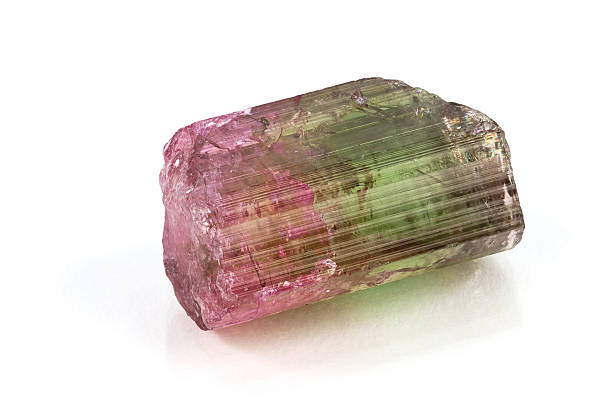
Tourmaline is a boron silicate mineral group that displays the widest colour range of any gem species. A single crystal can contain multiple colours (bi-colour and watermelon tourmaline). The name comes from the Sinhalese "toramalli," meaning mixed gems, because early gem traders in Sri Lanka grouped tourmaline with other coloured stones.
Physical Properties
Mohs hardness: 7 to 7.5. Refractive index: 1.624 to 1.644. Specific gravity: 3.02 to 3.26. Crystal system: trigonal. Tourmaline is pyroelectric and piezoelectric, meaning it generates an electric charge when heated or compressed. This property, discovered in the 18th century, gave tourmaline its early scientific interest.
Notable Varieties
Paraiba tourmaline: A neon blue-green to violet variety coloured by copper, discovered in Brazil's Paraiba state in 1989. Fine Paraiba tourmalines command $10,000 to $50,000 per carat. Similar copper-bearing tourmalines have since been found in Mozambique and Nigeria. Rubellite: Pink to red tourmaline. The finest rubellites rival ruby in colour. Chrome tourmaline: An intense green coloured by chromium, found in Tanzania and Kenya. Indicolite: Blue tourmaline, ranging from light to deep blue. Watermelon tourmaline: Pink center with green outer layer, sliced into cross-sections for display.
Major Sources
Brazil: historically the most important source, producing Paraiba, rubellite, and green tourmaline. Mozambique and Nigeria: copper-bearing tourmalines similar to Paraiba. Afghanistan (Nuristan): fine blue and green tourmalines. Madagascar, Sri Lanka, and the United States (California, Maine) also produce notable tourmaline.
Need a Tourmaline certified? GTCL provides comprehensive testing and certification for all gemstone types. Contact us →