Overview
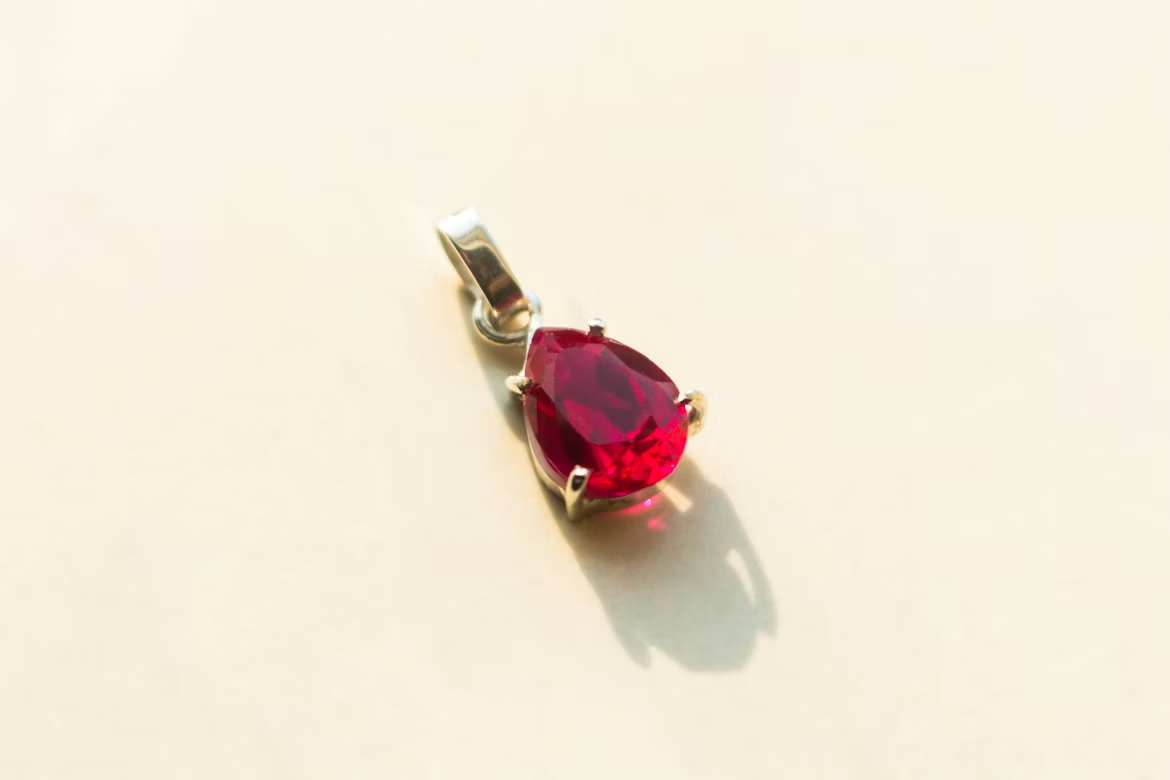
Ruby is the red variety of the mineral corundum (aluminium oxide, Al₂O₃), coloured by trace amounts of chromium. It is the most valuable variety of corundum and, carat for carat, can exceed diamond in price. The name comes from the Latin "rubeus," meaning red.
Physical Properties
Mohs hardness: 9 (second only to diamond). Refractive index: 1.762 to 1.770. Specific gravity: 3.97 to 4.05. Crystal system: trigonal (hexagonal). Rubies exhibit strong pleochroism, appearing purplish-red in one direction and orangish-red in another. Strong fluorescence under UV light is common in chromium-rich specimens, especially those from Myanmar.
Colour and Quality
The most prized ruby colour is "pigeon blood red," a vivid, slightly purplish red with medium to medium-dark tone and strong saturation. Low iron content (characteristic of Burmese rubies) allows chromium fluorescence to enhance the red colour, creating an internal glow that sets the finest rubies apart from all other red gemstones. Clarity expectations are lower for ruby than for sapphire. Fine rubies almost always contain silk (rutile needle inclusions), and some silk is actually desirable because it distributes colour evenly across the stone.
Major Sources
Myanmar (Burma): The Mogok Valley has produced the world's finest rubies for over 800 years. The marble-hosted deposits yield rubies with high chromium and low iron, creating the ideal conditions for vivid colour and strong fluorescence. Mozambique: The Montepuez region, discovered commercially around 2009, now produces the largest volume of gem-quality rubies in the world. Quality ranges from commercial to fine, with some stones approaching Burmese quality. Sri Lanka, Thailand, Madagascar, Tanzania, Vietnam, and Afghanistan also produce rubies of varying quality.
Vedic Significance
In Jyotish (Vedic astrology), ruby represents the Sun (Surya). It is prescribed to strengthen the Sun's position in the horoscope, promoting leadership, confidence, vitality, and success in government or authority-related matters. The stone should be natural, unheated, eye-clean, and set in gold. It is typically worn on the ring finger of the right hand on a Sunday during Shukla Paksha (waxing moon).
Treatment
Heat treatment is extremely common. Over 90% of rubies on the market have been heated to improve colour and clarity. Lead-glass filling is used to treat heavily fractured rubies, dramatically improving their apparent clarity but reducing durability. GTCL tests for and discloses all treatments on its certificates.
Need a Ruby certified? GTCL provides comprehensive testing and certification for all gemstone types. Contact us →