Overview
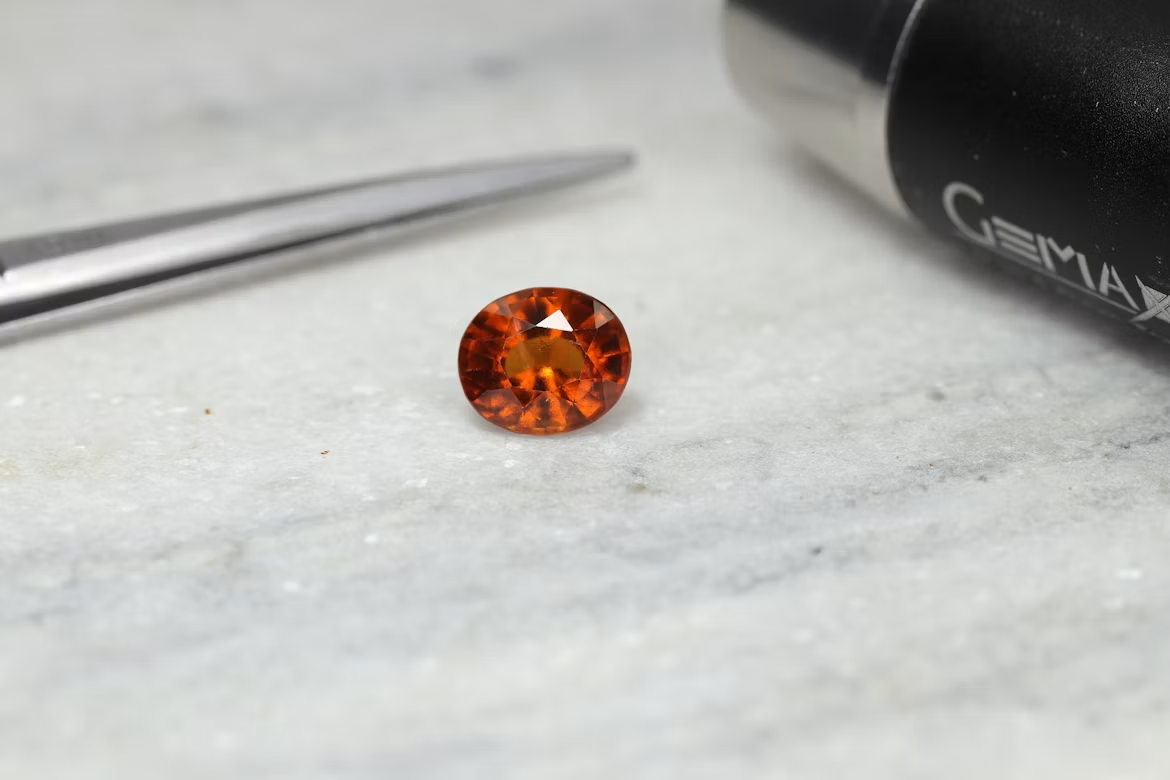
Hessonite is the honey-orange to cinnamon-brown variety of grossular garnet. Its name comes from the Greek "hesson," meaning inferior, because early gemologists considered it a less valuable garnet variety. In Vedic astrology, however, hessonite (Gomed) holds a position of significant importance as the gemstone of Rahu, the ascending lunar node.
Physical Properties
Mohs hardness: 6.5 to 7. Refractive index: 1.734 to 1.759. Specific gravity: 3.57 to 3.73. Crystal system: cubic. Hessonite is singly refractive. Its characteristic internal feature is a "treacly" or "heat wave" appearance caused by internal swirling, which gemologists describe as a scotch-in-a-glass effect. This feature is diagnostic and helps separate hessonite from other orange stones.
Colour and Quality
The ideal colour for Jyotish use is a warm, honey-orange to reddish-orange. Stones that are too brown, too pale, or with visible black inclusions are considered less effective. The "heat wave" effect is expected and does not reduce astrological value, but the stone should have good transparency and lustre.
Major Sources
Sri Lanka is the primary source of gem-quality hessonite. India (Odisha and Tamil Nadu) also produces hessonite. Madagascar, Brazil, and Canada (the Jeffrey Mine in Quebec) have produced notable specimens.
Vedic Significance
Hessonite (Gomed) represents Rahu, the shadow planet associated with worldly desires, foreign connections, sudden changes, and unconventional paths. It is prescribed when Rahu is favourably placed but weak, or when Rahu dasha (planetary period) is active. The stone should be set in silver or panchdhatu and worn on the middle finger of the right hand on a Saturday or Wednesday.
Need a Hessonite Garnet certified? GTCL provides comprehensive testing and certification for all gemstone types. Contact us →