Overview
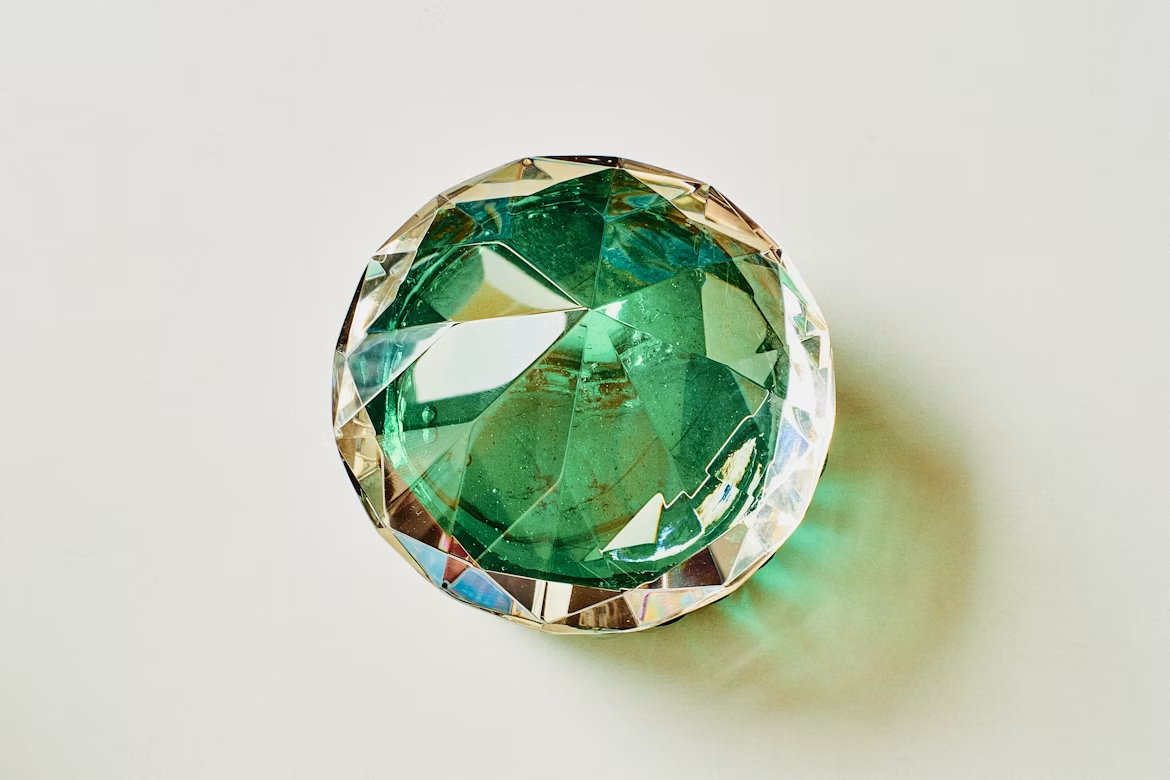
Emerald is the green variety of the mineral beryl (Be₃Al₂Si₆O₁₈), coloured by trace amounts of chromium and sometimes vanadium. Cleopatra was famously obsessed with emeralds, and Colombian emeralds have driven treasure expeditions since the Spanish conquest. The name derives from the Greek "smaragdos," meaning green stone.
Physical Properties
Mohs hardness: 7.5 to 8. Refractive index: 1.565 to 1.602. Specific gravity: 2.67 to 2.78. Crystal system: hexagonal. Despite reasonable hardness, emeralds are considered brittle because they almost invariably contain fractures and inclusions (termed "jardin," the French word for garden). This internal character is accepted and even expected by the trade.
Colour and Quality
The ideal emerald colour is a vivid, medium-toned green with slight blue secondary hue. Colombian emeralds tend toward a warmer, slightly yellowish green, while Zambian emeralds lean cooler and slightly bluish. Both colour profiles have strong market demand. Clarity expectations are lower than for any other major gemstone; a heavily included emerald can still command high prices if the colour is exceptional.
Major Sources
Colombia: The Muzo, Chivor, and Coscuez mines produce the world's most valued emeralds. Colombian emeralds typically form in sedimentary host rock (black shale) rather than metamorphic environments. Zambia: The Kagem mine is the world's single largest emerald mine by production. Zambian emeralds offer excellent clarity relative to Colombian stones. Brazil, Ethiopia, Afghanistan, and Rajasthan (India) also produce emeralds.
Vedic Significance
Emerald (Panna) represents Mercury (Budh) in Vedic astrology. It is prescribed for strengthening communication skills, intellect, business sense, and analytical ability. The stone should be natural, minimally treated, and set in gold. It is worn on the little finger of the right hand on a Wednesday.
Treatment
Oiling and resin filling are standard and expected. Cedar oil or synthetic polymers fill surface-reaching fractures, improving apparent clarity. Minor oiling is widely accepted; heavy filling is considered a significant treatment. GTCL grades the level of clarity enhancement as none, minor, moderate, or significant.
Need a Emerald certified? GTCL provides comprehensive testing and certification for all gemstone types. Contact us →