
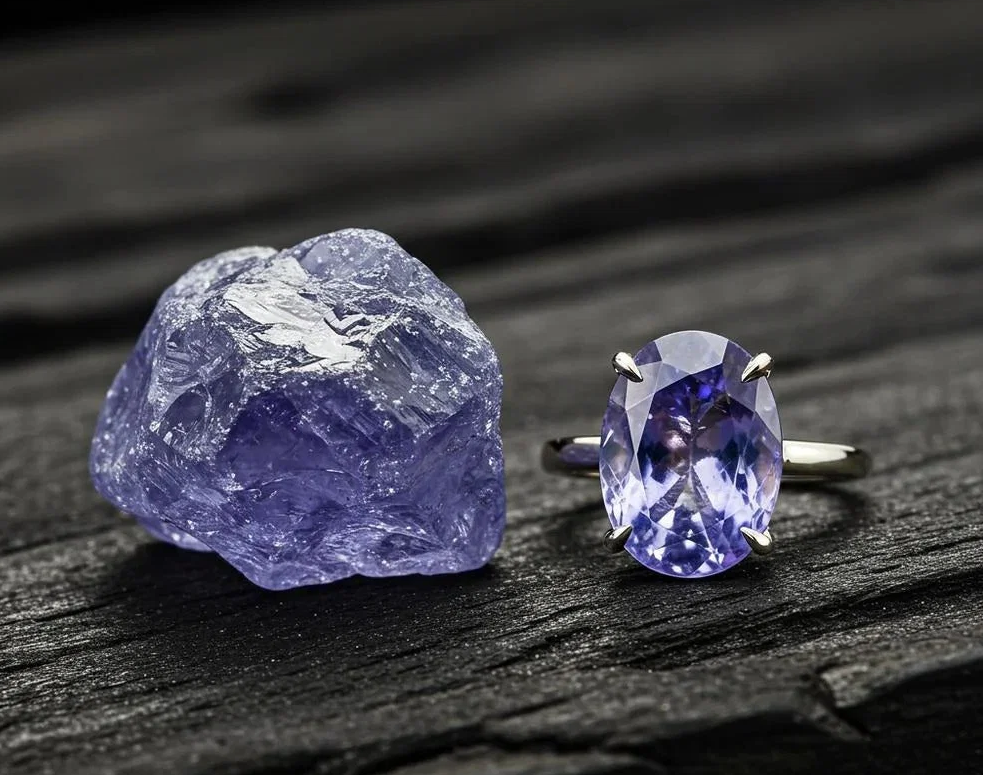
Overview
Tanzanite is the blue-violet variety of the mineral zoisite, found in only one location on Earth: the Merelani Hills near Mount Kilimanjaro in Tanzania. Discovered in 1967, it was named and marketed by Tiffany & Co. Tanzanite quickly became one of the most popular coloured gemstones, prized for its vivid blue-violet colour that rivals sapphire at a fraction of the price.
Physical Properties
Mohs hardness: 6 to 7. Refractive index: 1.691 to 1.700. Specific gravity: 3.35. Crystal system: orthorhombic. Tanzanite shows strong trichroism: blue, violet, and burgundy depending on viewing direction. After heat treatment (which is standard), the stone appears predominantly blue to violet.
Colour and Quality
The most valued tanzanites display a vivid, saturated blue with violet secondary hue at medium to medium-dark tone. The colour should be visible in a range of lighting conditions. Stones above 5 carats with fine colour are significantly more valuable per carat than smaller stones. Natural-colour (unheated) tanzanite in fine blue-violet is extremely rare and commands a premium.
Treatment
Over 95% of tanzanites on the market have been heated. The rough typically appears brownish-violet and is heated to 450 to 700°C to shift the colour to blue-violet. This treatment is permanent and universally accepted. Unheated tanzanite in natural blue-violet colour is extremely rare.
Investment Consideration
Tanzanite's single-source nature makes it a subject of investment interest. Geological studies suggest the Merelani deposit may be depleted within 25 to 30 years at current mining rates. If this projection holds, fine tanzanite could appreciate significantly in value. However, gemstone investment carries risks, and predictions about deposit exhaustion have been wrong before.
Need a Tanzanite certified? GTCL provides comprehensive testing and certification for all gemstone types. Contact us →